Introduction
Having spent over three decades in healthcare—starting as a nursing assistant and evolving into roles like biomedical technician, EHR analyst, and now a product analyst supporting medical record scanning technology—I’ve seen firsthand how medical diagnostics have changed. AI’s integration into healthcare isn’t just another tech trend. It’s a fundamental shift, redefining how we detect diseases early and personalize treatments for each patient.
AI-Powered Medical Imaging
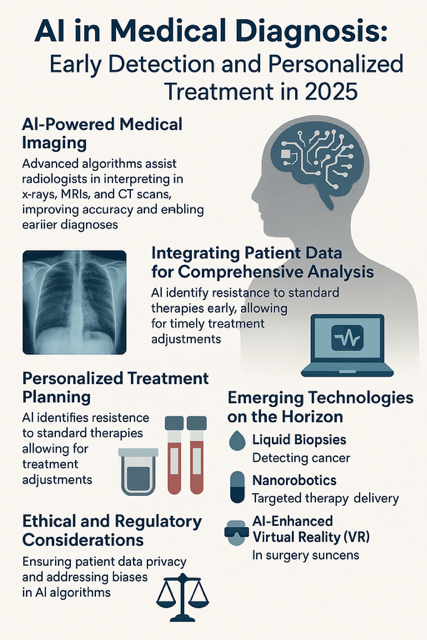
The impact of AI on medical imaging is nothing short of revolutionary. Advanced algorithms now assist radiologists in interpreting X-rays, MRIs, and CT scans with remarkable precision. Take AIIMS Patna, for example—they’ve embraced AI-powered diagnostic tools to improve patient care, significantly enhancing the accuracy of detecting conditions like cancer and heart disease. These AI-driven systems identify subtle patterns that might escape the human eye, leading to earlier and more precise diagnoses.
Integrating Patient Data for Comprehensive Analysis
AI’s potential goes beyond imaging. It’s changing how we analyze massive amounts of patient data to predict health outcomes. Researchers at Mass General Brigham have developed an AI tool that can predict cognitive decline years before symptoms emerge by analyzing brainwave patterns recorded during sleep. These predictive insights empower doctors to intervene earlier, slowing disease progression and ultimately improving patients’ quality of life.
Personalized Treatment Planning
AI isn’t just helping doctors diagnose diseases—it’s transforming how treatments are planned. A recent study presented at the American Society of Clinical Oncology meeting highlighted AstraZeneca’s experimental pill, camizestrant, which reduced the risk of disease progression or death by 56% in women with advanced hormone receptor-positive, HER2-negative breast cancer. By using a liquid biopsy to detect early resistance to standard therapies, doctors can adjust treatments sooner, giving patients better outcomes.
Emerging Technologies on the Horizon
The next wave of AI-driven medical innovations is already here. Some of the most promising advancements include:
- Liquid Biopsies – The UK’s NHS has introduced a groundbreaking blood test that detects cancer in its earliest stages, offering new hope for lung and breast cancer patients.
- Nanorobotics – Scientists are developing tiny robots capable of traveling through the bloodstream to deliver targeted therapies, an advancement that could revolutionize treatment methods.
- AI-Enhanced Virtual Reality (VR) – Surgeons are using VR technology to plan complex procedures and educate patients, improving surgical precision and patient understanding.
Ethical and Regulatory Considerations
As AI’s role in healthcare expands, ethical concerns must be addressed. Protecting patient privacy, minimizing biases in AI algorithms, and developing clear regulatory standards are essential to maintaining trust in AI-powered diagnostics. Responsible implementation will ensure AI remains a valuable tool without compromising patient safety.
Conclusion
The fusion of AI with medical diagnostics marks a new era in healthcare—one where early detection and personalized treatment aren’t futuristic concepts but everyday realities. AI isn’t here to replace human expertise; it’s here to enhance it, allowing doctors to work more efficiently and improve patient outcomes. As healthcare continues to evolve, AI will remain at the forefront, helping to shape a smarter, more responsive system that benefits everyone.
 Innovate with Ai