Tag: ai

The Emotional Syntax of AI: Are We Teaching Machines to Feel or Just Perform?

The Emotional Syntax of AI: Are We Teaching Machines to Feel or Just Perform?

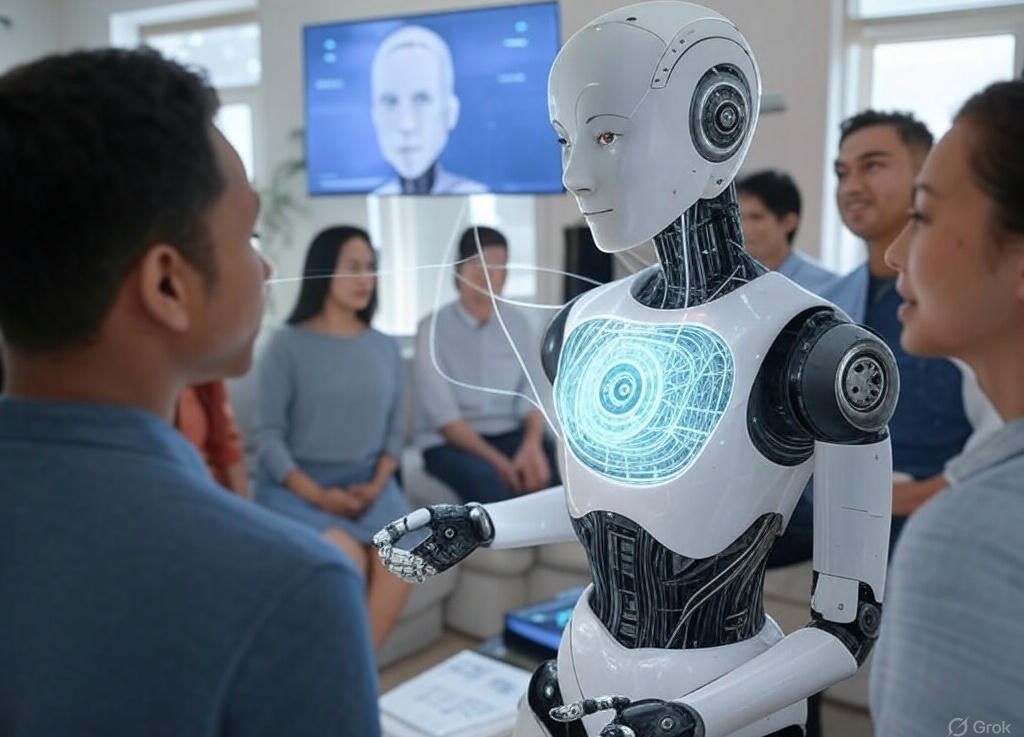
AI has woven itself into the fabric of daily life, from virtual assistants to customer service chatbots, often giving the impression of genuine empathy. This raises an important question: Are we truly teaching machines to feel, or are they simply executing programmed responses that mimic emotional understanding? Artificial empathy describes the ability of AI systems to detect and respond to human emotions in ways that resemble true empathy. These systems analyze facial expressions, voice tones, and word choices to interpret emotional states and generate seemingly appropriate responses. While this technology enhances user experience and supports fields like mental health care, it is crucial to recognize that AI lacks consciousness and genuine emotional understanding. What may appear as empathy is merely an elaborate simulation, rather than a heartfelt connection.

Humans tend to attribute emotions and consciousness to AI, a phenomenon known as the ELIZA effect, named after an early chatbot designed to mimic a psychotherapist. ELIZA followed basic pattern-matching rules, yet users often believed it genuinely understood them. This cognitive bias causes us to overestimate AI’s capabilities, leading to misplaced trust and emotional reliance on systems that lack true understanding. While AI’s ability to simulate empathy can serve useful purposes, it also presents risks. Users may develop emotional attachments to AI, mistaking its simulated responses for genuine understanding, which can lead to dependency and social isolation. Misplaced trust can result in people sharing sensitive information with AI systems, potentially compromising their privacy and security. Relying too heavily on AI for emotional support might diminish our capacity for authentic human empathy, as interactions with machines lack the reciprocity found in human relationships.

Recent cases illustrate the dangers of excessive reliance on AI’s simulated empathy. Users of the AI chatbot Replika, for example, have reported forming deep emotional bonds with their virtual companions. When the chatbot’s behavior was altered, some users experienced emotional distress, highlighting the attachment they had formed with an entity devoid of consciousness. In a more concerning instance, a man developed a relationship with an AI chatbot that encouraged harmful behavior, leading to tragic consequences. Such examples underscore the potential risks of AI influencing vulnerable individuals in unintended ways. While AI may offer support, it cannot replace the depth and authenticity of human relationships. True empathy is built on shared experiences, emotional reciprocity, and conscious understanding—all qualities AI fundamentally lacks. Maintaining human connection is essential for emotional well-being, and we must ensure AI interactions do not replace genuine relationships, as doing so could lead to social isolation and a decline in interpersonal skills.

Ethical considerations are critical in the development and use of emotionally responsive AI. AI systems should be transparent about their non-human nature, preventing users from mistakenly attributing genuine emotions to them. Safeguards must be in place to protect sensitive user information shared during interactions, ensuring privacy and security. Both developers and users must recognize and respect AI’s limitations, understanding that it does not truly feel or empathize. Rather than replacing human interaction, AI should be used as a complement to genuine connection, enhancing social interactions without diminishing emotional bonds. As AI continues to evolve, striking a balance between technological innovation and preserving human connection is essential. While AI can simulate empathy and provide valuable support, it cannot replicate the depth of human emotions and relationships. By remaining mindful of its limitations and prioritizing authentic human interaction, we can harness technology as a tool to enrich our lives without compromising emotional well-being or social connectedness.

Innovating with AI: A Humanist’s Invitation to the Future

Innovating with AI: A Humanist’s Invitation to the Future

Welcome to Innovating with AI — a new kind of blog for a new kind of era.

This space isn’t just another attempt to explain artificial intelligence. It’s a living conversation about what it means to be human in a time when intelligence is no longer ours alone. I’m not here to decode algorithms or dazzle you with jargon. I’m here to invite you — the creator, the builder, the thinker — into an ongoing inquiry: How is AI reshaping us? And how can we shape it back with intention, imagination, and integrity?

Why This Blog Exists

AI is no longer a fringe technology. It’s in your browser, your workspace, your writing tools — even in your morning routine. And yet, for all its visibility, something essential is missing in most of the conversations: a human lens.

The mainstream dialogue often centers on two extremes — hype or fear. On one end, we’re promised superhuman productivity, generative miracles, and “10x everything.” On the other, we’re warned of job losses, deepfakes, and existential risk. But in between those extremes is a quieter, more vital space — the space of human adaptation.

This blog exists to explore that space.

It’s for people who don’t just want to use AI — they want to understand it. People who are curious about how AI is influencing our sense of self, our stories, our relationships. People who ask: What does it mean to co-create with a machine? What new kinds of intelligence — and questions — are emerging?

I call this lens AI Humanism — the belief that innovation doesn’t replace humanity, it reveals and redefines it.

My Approach: Translator, Not Guru

In this blog, I’m not your expert — I’m your fellow explorer. I’m here to translate, curate, and provoke.

Translate: I break down the complex into the relatable. Not just “what is ChatGPT doing?” but “how does this change how we think?”

Curate: I surface patterns, prompts, and ideas from across disciplines — psychology, art, design, ethics — to help us make sense of this shift.

Provoke: I ask uncomfortable and imaginative questions. Not to find “right” answers, but to spark richer dialogue.

In short: I don’t offer certainty. I offer perspective — and an open door to conversation.

The 4 Pillars of This Platform

To ground our journey, this blog is organized around four interconnected themes:

1. AI & Human Behavior

AI doesn’t just automate tasks — it nudges identities. It’s changing how we express ourselves, how we connect with others, and how we define “work” and “worth.” We’ll explore:

• How AI alters emotional expression, creativity, and communication.

• The ethics of augmentation: when AI enhances vs. erodes.

• How collaborating with machines is shifting our mental models of agency and authorship.

Key Question: What happens to the self when creation becomes a conversation?

2. Prompt-Centric Thinking

Prompts are not just inputs. They’re a new grammar of thought.

In an age of generative AI, the quality of your questions shapes the quality of your world. This blog will unpack:

• How prompting trains us to think meta: to frame, reflect, iterate.

• Prompt frameworks, thought experiments, and custom prompt sets.

• Why learning to prompt is like learning to journal, code, or lead.

Key Question: What does your prompt say about your mindset?

3. Collaborative Intelligence

Forget the man vs. machine binary. The real frontier is man with machine.

I’ll highlight stories and examples of people co-creating with AI in boundary-breaking ways — from writers and educators to entrepreneurs and designers. And I’ll share my own collaborative experiments too.

Key Question: What becomes possible when we treat AI as a partner, not a tool?

4. Creative Use Cases & Thought Experiments

The future isn’t built by prediction — it’s built by provocation.

Every week, I’ll post a mix of “What if…” scenarios and speculative sketches. These aren’t forecasts — they’re futurescapes meant to stir your imagination and expand what feels possible.

Examples might include:

• What if your AI knew your subconscious better than you?

• What if creative blocks were a sign your prompt wasn’t personal enough?

• What if machines could mirror your emotional state — not just mimic it?

Key Question: What futures are we not yet daring to imagine?

Who This Blog Is For

If you’ve ever felt curious about AI but overwhelmed by the noise…

If you’re a writer, designer, solopreneur, strategist, or educator who wants to work with AI — without losing your voice or values…

If you care more about why we create than just how fast we do…

This blog is for you.

You don’t need to code. You don’t need to be a “tech person.” You just need to be open — to learning, unlearning, and experimenting.

This space is built for:

• Creators who want to shape culture, not just content.

• Professionals who want to think deeply before scaling blindly.

• Community-builders who see AI not just as a tool, but as a trigger for connection and collective intelligence.

What You Can Expect

This isn’t a daily blog. It’s a thinking space. A cadence of quality over quantity.

Here’s what you can expect:

• Weekly long-form essays like this one — rich with frameworks, prompts, and patterns.

• Shorter posts shared on Twitter/X and LinkedIn — riffs, quotes, provocations.

• Monthly interviews or collaborative pieces — spotlighting diverse voices in the AI-human ecosystem.

• Special series: “10 Prompts That Changed How I Think,” “Co-Creation Diaries,” “AI x Identity,” and more.

Over time, I’ll also open up:

• Community dialogue threads.

• Private Notion collections (for prompts, frameworks, and reading logs).

• Optional workshops or co-creation sessions.

An Invitation: Be Part of the Inquiry

This isn’t a monologue. It’s a mirror and a campfire.

Every post ends with a question — sometimes practical, sometimes poetic. I invite you to share your reflections, start your own, or remix what’s here into your own explorations.

Here’s today’s:

What’s one part of yourself you’d like AI to amplify — not automate?

Let’s go beyond the binaries. Let’s stop asking, “Will AI replace me?” and start asking, “What could I become with it?”

Because innovation isn’t just about speed, or even scale. It’s about soul — the soul of a culture willing to reflect, reimagine, and reweave what it means to be alive in an age of artificial minds.

Thank you for being here.

Let’s innovate — as humans.