I’ve been thinking a lot lately about how artificial intelligence is showing up in creative spaces. Not just helping behind the scenes, but actually making stuff. Writing, drawing, composing music. And yeah, sometimes the results are surprisingly good.
You can type in a few words, and boom, you’ve got a song, an illustration, or a story draft. It’s impressive. But I also get why some folks are uneasy about this. Especially people who’ve spent years learning their craft. There’s a tension between excitement and concern that keeps coming up.
What We Might Be Losing
For a lot of people, creativity isn’t just about making something that looks or sounds good. It’s about the story behind it. The lived experience. That rough edge that makes something feel human. Like when a smell brings back a memory, or when a song hits you right in the chest because it came from a real place.
That’s the part we don’t want to lose. It’s not just about protecting jobs, though that’s a big part of it. It’s also about wondering what it means if a machine can do what we do. Does it mean our work wasn’t as special as we thought?
I’ve talked to illustrators, copywriters, musicians—all of them asking the same question in different words: “If AI can mimic the look, the sound, the feel of what I do, then what’s left for me?” That question isn’t easy to answer.
There’s something uniquely messy in art. The imperfect cadence of a guitar riff, the slight misstep in a drawing, the handwritten note that’s slightly off-center. Those little “flaws” often carry meaning. They hint at a human being behind the work. When everything becomes too perfect, something gets lost.
I don’t mean to glamorize struggle for struggle’s sake. I’ve spent years pushing through projects, pivoting from nursing assistant to aeromedical technician to IT product analyst. I know what “getting after it” means. But part of that process is the reflection, the pause, the mistake and it feeds into creativity. When you remove that, you risk art that feels hollow.
What We Might Be Gaining
On the flip side, I’ve also seen how AI can really help. It can take care of the repetitive parts, draft ideas faster, and suggest directions when you’re stuck. It’s like having a super-fast assistant who’s always ready to jump in.
Imagine you’re a designer trying to generate logos for a client. You might hand-sketch a few, then refine one or two before showing. With AI you could generate fifty variations in seconds, then pick two, refine those, and move ahead. That doesn’t replace your creative vision. It just gives you more breadth to work from.
Or imagine you’re a writer and you hit the dreaded blank page. You open an AI tool and ask: “Give me five inciting incidents for a sci-fi story.” You pick one, feel the spark, then shape it. The tool didn’t write the final story, but it helped you through the block.
In music, producers are blending AI-generated loops with live instrumentation. The result: something that feels both futuristic and deeply human. It’s not “machine music” in the cold sense, it’s a hybrid. And that hybrid is interesting because it takes something familiar and skews it just enough.
The wider the toolkit, the more options. That’s what I find exciting. If you’re open to it, you might find you can go places you never planned to go.
The Middle Ground: Humans + AI
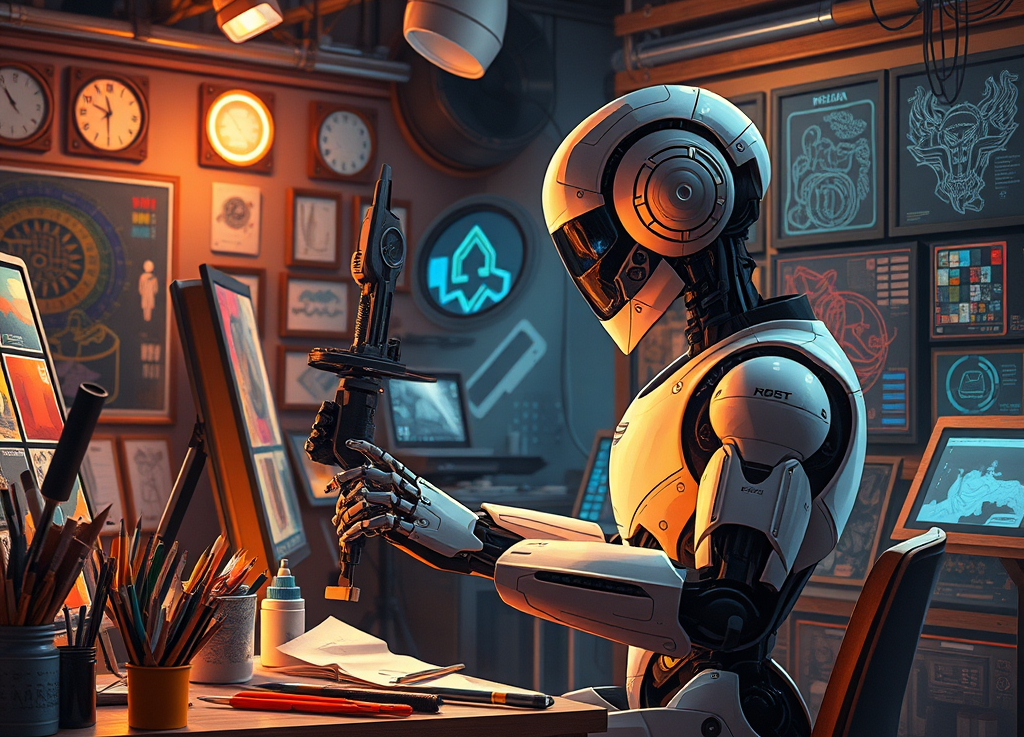
Personally, this is where I land. It’s not about choosing one side. It’s not about either AI or human creativity. It’s about how they can work together. A tool is just a tool. It’s how you use it that makes the difference.
Think of it like the camera in the 19th century. When photography came along, painters freaked out. “This will kill art!” they said. But it didn’t. It evolved. Painters didn’t have to chase realism anymore. They explored emotions, light, abstraction, and new movements like Impressionism followed. Maybe AI is that kind of shift.
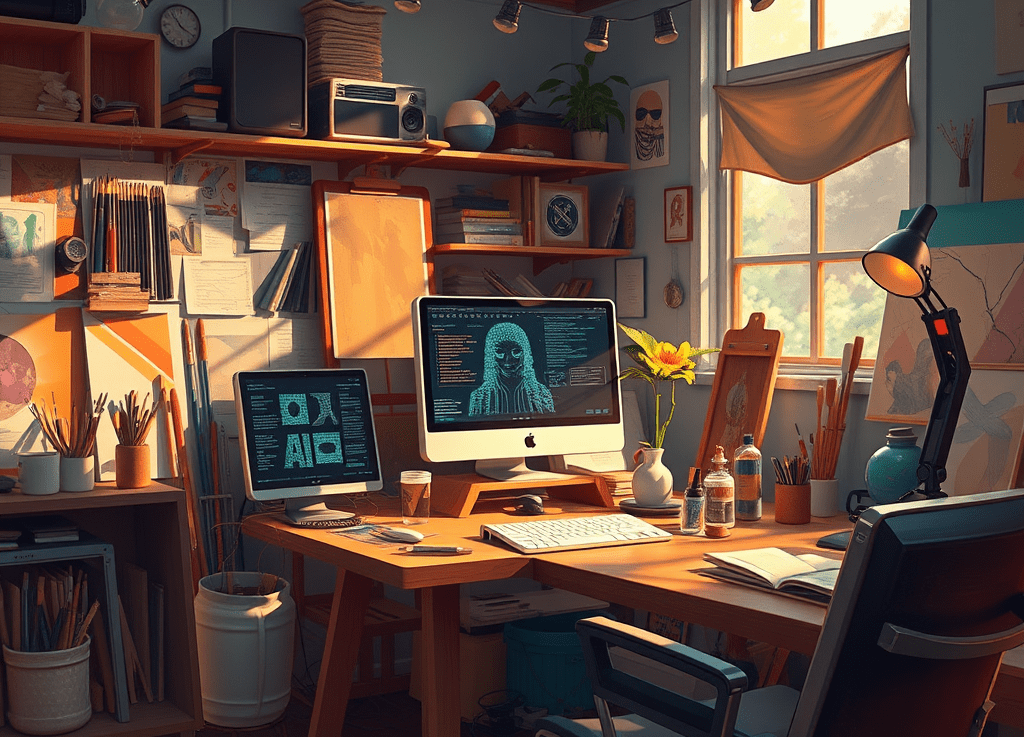
When you use AI as a brush, not the painter, you expand what you can do. You don’t hand over your role, you amplify it. You still make the meaningful choices. You still bring the lived experience. The machine just helps you hack through parts of the process so you can focus on what you’re uniquely good at.
The Big Questions We’re Still Sorting Out
Of course there are some things we haven’t figured out yet. Let’s dig into a few.
Who Owns the Work?
When an AI model generates output that mimics thousands of artists’ works (sometimes without explicit permission), what does authorship mean? If you ask a model to produce something “in the style of” a well-known creator, is it derivative? Are you building on their legacy or riding it? The laws are playing catch-up.
What About Bias and Homogeneity?
A lot of AI tools are trained on data that mostly reflects Western, male, English-speaking voices. If you build creative output from that base, you risk a flood of work that looks diverse but feels the same. That’s a less obvious problem, but a real one. If we’re not careful we’ll replace variety with algorithmic “variety” that doesn’t hit as hard.
What Gets Replaced and What Doesn’t?
Some jobs may change. Some may disappear. But I don’t think it’s an apocalypse. I think it’s transformation. The people who thrive will be those who can ask: “Where can I let the machine help? Where do I need to take over?” The answer will vary by craft, by person, by context.
What Gives Me Hope
I’ve heard about writers who join workshops where they co-author short stories with AI. At first everyone is hesitant. The outputs feel weird. They poke at them like they’re a strange new ingredient in the kitchen. But by the end something surprising happens.
The AI lays down structure and dialogue like a skeleton. The humans layer in the flesh, the humor, the metaphor, the heart. One writer told me it felt like jamming with a tireless bandmate who never argues about tempo.
That’s the future I want to believe in. Not AI versus humans. AI and humans. A real partnership. And if we focus on that, the results could be more interesting than anything we’ve done yet.
Where We Go From Here
So if that’s the kind of future I hope for, what do we do now? A few ideas:
Teach the Thinking and the Tool
Art schools and creative programs should cover not just tools like Photoshop or Pro Tools, but how to think with AI. That means: how to write good prompts, how to critique machine output, how to know when to step in and when to step back.
Build Communities, Not Just Products
Online communities, Slack groups, forums—these are already buzzing with people leaning into AI prompts and sharing hacks. That kind of peer-to-peer learning is gold. When someone says, “Here’s how I used it to break writer’s block,” you learn faster than by any solo experiment.
Keep the Human Element in the Driver’s Seat
Even as the tools scale, I believe the human touch matters. In commercial fields, maybe deadlines shrink and volume rises. But in fine art, literature, deep music work, the human will still lead. And that’s okay. Not everyone has to use AI the same way.
Embrace the Possibility
We’re still early in this whole thing. But imagine where it might go:
Art that responds to your mood
Music that shifts based on what the crowd is feeling
Stories that adapt in real time as you read
These aren’t just sci-fi fantasies. They’re in reach, if we build them thoughtfully.
TL;DR
Creativity is shifting thanks to AI, but the human part still matters
We might lose some of the lived-experience edge, but we gain new tools and speed
The sweet spot is humans and machines working together
Big questions remain—ethics, bias, ownership—and we shouldn’t avoid them
Education, communities, and curiosity will shape where this all goes
CTA
If you’re working in creative tech, thinking about how AI fits into your workflow, or just curious about where this goes next, I’d love to have you join the conversation. Subscribe to my newsletter to get updates on how I’m exploring this intersection of human creativity and AI tools (and how you can too).
Let’s keep experimenting, learning, and building something new together.
 Innovate with Ai