In the last few years, artificial intelligence has quietly moved from the background of technology into the center of the creative process. What started as tools for data analysis and automation has evolved into something far more personal and expressive. Today, AI is helping artists, designers, marketers, and everyday creators bring visual ideas to life in ways that were simply not possible before.
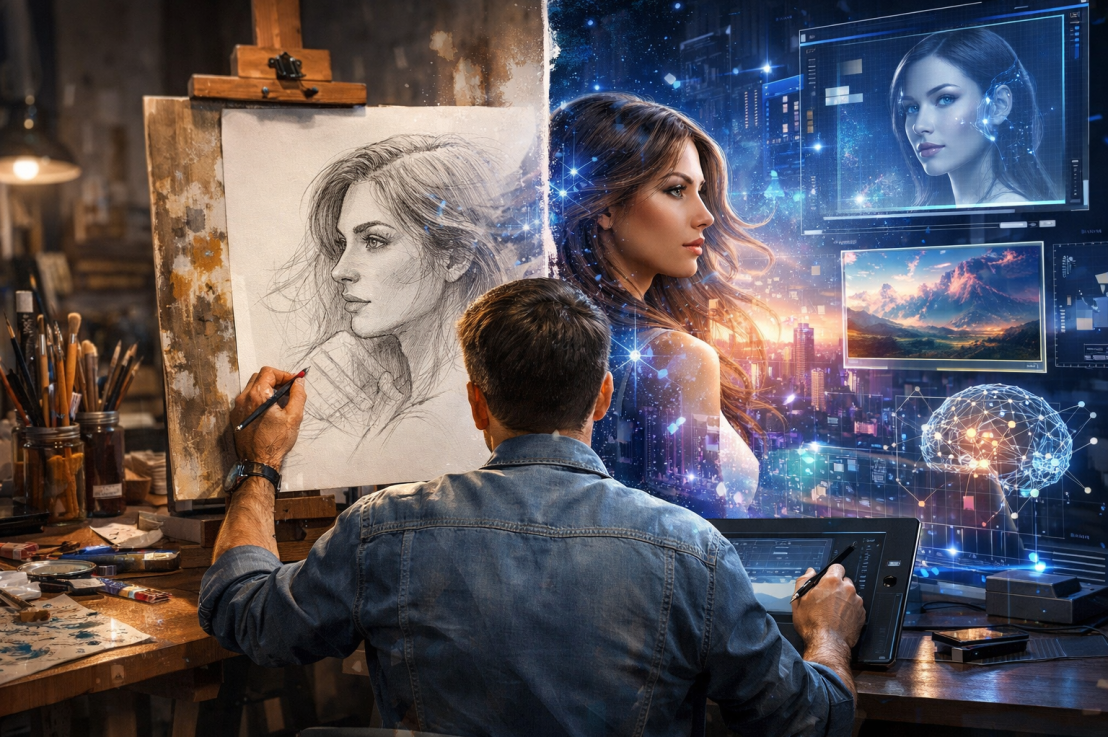
I have seen this shift firsthand. As someone who actively builds and experiments with custom GPTs, I have created tools like an image creation agent and a sketch interpreter to support my own creative workflows. These systems are not about replacing creativity. They are about extending it, speeding up the rough drafts, and helping ideas take shape when words or sketches alone are not enough.
AI image and video generation sit at the heart of this creative transformation. They blend technical innovation with human imagination, reshaping how we think about art, design, and visual storytelling.
The Core Techniques Behind AI Image and Video Generation
To understand why AI-generated visuals have improved so rapidly, it helps to look at the techniques behind them. While the math and code can get complex, the core ideas are surprisingly intuitive.
Generative Adversarial Networks, commonly known as GANs, were a major breakthrough in visual AI. The concept is based on competition. One neural network, called the generator, creates images. Another, called the discriminator, judges whether those images look real or fake.
Over time, the generator learns from its mistakes. Each iteration produces better results until the images become difficult to distinguish from real photographs or artwork. This technique has been used to create digital art, enhance old photos, design fictional characters, and even simulate realistic environments for games and films.
What makes GANs especially interesting from a human perspective is how they mimic creative feedback. The generator improves not because it knows what beauty is, but because it is constantly being challenged and corrected. In many ways, it reflects how artists grow through critique and iteration.
Convolutional Neural Networks, or CNNs, are another foundational technology behind AI visuals. Unlike GANs, CNNs focus on understanding images rather than inventing them from scratch.
CNNs analyze visual data by recognizing patterns such as edges, textures, shapes, and motion. This makes them essential for tasks like image recognition, video frame analysis, style transfer, and video enhancement. In video generation, CNNs help models understand how frames relate to each other, allowing for smoother motion and more coherent sequences.
When combined with generative techniques, CNNs allow AI to not only create images but also understand context, structure, and visual consistency.
One reason AI image and video generation has spread so quickly is accessibility. What once required deep technical expertise is now available through user-friendly platforms that encourage experimentation.
One of the most well-known tools in this space is DALL·E, developed by OpenAI. It allows users to generate images simply by describing them in text. This removes a major barrier to visual creation. You no longer need advanced drawing skills or expensive software to explore visual ideas.
For creators like me, tools like DALL·E become brainstorming partners. They help visualize concepts early, spark new directions, and sometimes produce unexpected results that inspire better ideas.
Artbreeder focuses on image blending and evolution. Users can mix portraits, landscapes, and abstract art, adjusting sliders to explore variations. It feels less like issuing commands and more like collaborating with a living system.
This kind of tool highlights an important point. AI creativity is often at its best when it invites human guidance rather than replacing it.
Runway ML has become a favorite among video creators. It offers real-time video editing, background removal, motion tracking, and generative effects powered by machine learning. For filmmakers and content creators, it shortens production cycles and opens doors to techniques that once required entire teams.
DeepArt specializes in style transfer, allowing users to apply artistic styles inspired by famous painters to their own photos. While style transfer is not new, tools like this made it mainstream and approachable, helping people see their everyday images in a new light.
Despite the technical foundations, the most important element in AI-generated visuals is still human intention. AI does not wake up with an idea. It does not feel curiosity or emotion. Those come from the person guiding it.
When I built my custom GPTs, including an image creation agent and a sketch interpreter, my goal was simple. I wanted tools that could meet me halfway. The image creation agent helps translate abstract ideas into visuals quickly, while the sketch interpreter turns rough drawings into more refined concepts. Neither replaces my creative judgment. They simply accelerate the early stages of the process. This human in the loop approach is where AI shines. It removes friction while preserving authorship. AI image and video generation is already reshaping multiple industries, often in subtle but powerful ways.
Marketing teams use AI-generated visuals to prototype campaigns, test concepts, and personalize content at scale. Instead of relying solely on stock photos, brands can generate visuals tailored to specific audiences, moods, and messages. This reduces costs and increases creative flexibility.
In film, television, and gaming, AI assists with concept art, environment design, and even character animation. It speeds up pre-production and allows creative teams to explore more ideas before committing resources. In games, AI-generated assets help small studios compete with larger ones.
AI-generated visuals are especially valuable in education. Complex topics become easier to understand when supported by clear images and animations. From medical diagrams to historical reconstructions, AI helps educators create engaging materials without specialized design skills.
Designers use AI to explore patterns, textures, and forms that would take weeks to prototype manually. AI-generated concepts act as creative prompts rather than finished products, helping designers push boundaries while staying in control of the final outcome.
With new power comes new responsibility.
AI-generated visuals raise important questions about authorship, originality, and misuse. Deepfakes, misinformation, and copyright concerns are real issues that deserve attention.
The solution is not to reject the technology but to use it thoughtfully. Transparency, ethical guidelines, and respect for original creators must be part of the conversation. As creators, we set the tone for how these tools are used.
The future of AI image and video generation is not about machines replacing artists. It is about collaboration becoming more fluid. We will see tools that understand context better, respond more naturally to creative feedback, and integrate seamlessly into existing workflows.
Custom systems like the GPTs I build today are just the beginning. As models become more adaptable, creators will shape AI tools to fit their personal styles rather than adjusting their styles to fit the tools.
AI image and video generation represent one of the most exciting intersections of technology and creativity in our time. These tools are not magic, and they are not shortcuts to meaningful work. They are amplifiers. They amplify imagination, speed, and experimentation when guided by human vision. By embracing AI as a creative partner, not a replacement, we unlock new ways to tell stories, share ideas, and explore visual worlds. The future of visual creation is not automated. It is collaborative, expressive, and deeply human.
 Innovate with Ai